

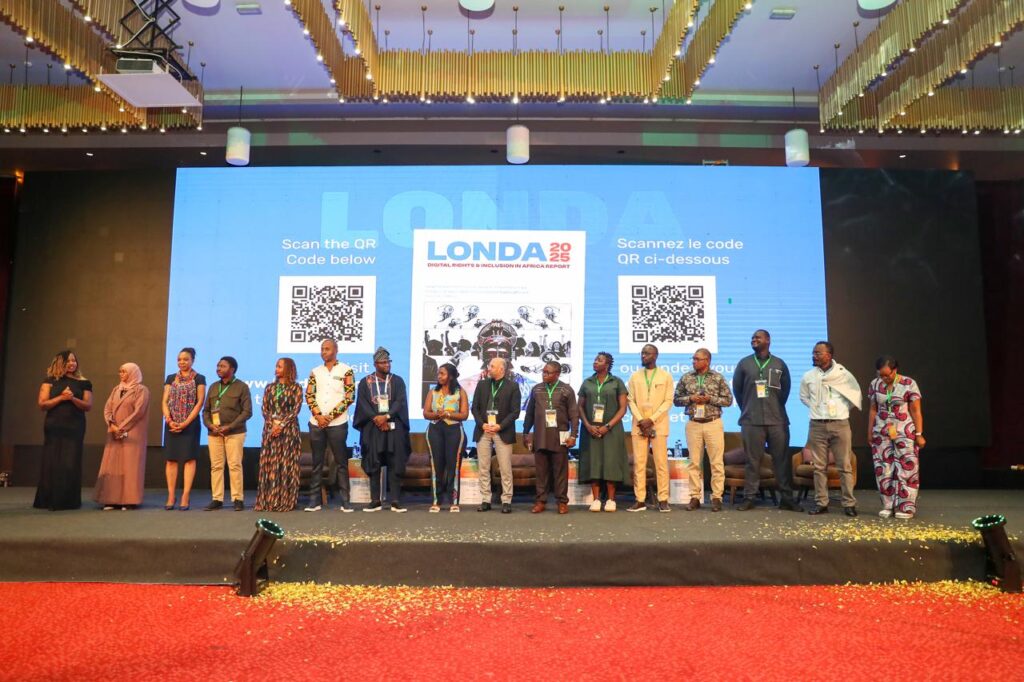
a section of the Londa Report authors on stage during the report launch in Abidjan ,Cote’d’Ivoire.Photo Courtesy Paradigm Inittiative.
digital Rights
Kenya has been urged to end internet shutdowns during protests, strengthen data protection enforcement, and fast-track regulation of artificial intelligence after a new continental report ranked the country among Africa’s top performers in digital rights and inclusion.
According to the Digital Rights and Inclusion in Africa (Londa) 2025 Report, by Paradigm Initiative (PIN), which placed Kenya sixth out of 29 African countries assessed on digital rights protections and internet inclusion.
Despite the improved ranking, the report says Kenya must address persistent challenges affecting online freedoms, including internet disruptions during demonstrations, gaps in privacy enforcement, and inequalities in internet access between urban and rural areas.
The report recommends repealing overbroad provisions in the Computer Misuse and Cybercrimes Amendment Act, 2024, adequately funding the Office of the Data Protection Commissioner, developing a comprehensive Artificial Intelligence regulatory framework, and harmonising policies governing cross-border data transfers and cloud services.
The report also urges the government to prioritise affordable internet connectivity in rural, informal, and marginalised communities to narrow the country’s digital divide.
The recommendations come as Kenya posted one of the biggest improvements among the continent’s leading performers, climbing three places from ninth in 2024 to sixth this year after scoring 37 out of 60, an improvement of three points.
The report ranks South Africa as Africa’s best-performing country on digital rights for the second consecutive year with a score of 47 points. It is followed by Ghana, Namibia, Senegal, Egypt, Zambia, Kenya, Rwanda, Malawi, and Nigeria.
Kenya and Rwanda are the only East African countries to feature in the top ten. Rwanda retained its score of 36 points, performing strongly in digital infrastructure and e-government but recording lower scores on freedom of expression and arbitrary arrests.
According to the report, Kenya continues to boast one of Africa’s most vibrant media environments, supported by an active civil society and a rapidly growing digital economy. However, it warns that journalists continue to face harassment and intimidation, while restrictive laws affecting press freedom remain in force.
The report also raises concern over internet throttling and network disruptions during protests, saying such actions undermine freedom of expression and citizens’ access to information.
Compiled through legal and policy analysis, secondary data, interviews with regulators and industry stakeholders, and media monitoring, the Londa report is regarded as one of Africa’s most comprehensive assessments of digital rights and inclusion.
Across the continent, Botswana and Egypt recorded the largest improvements, each moving up more than nine places in the rankings. Nigeria dropped five places, while Cameroon fell by ten positions. Mozambique, the Democratic Republic of the Congo, and Sudan were ranked among the weakest performers.
