

By:Betty Luke
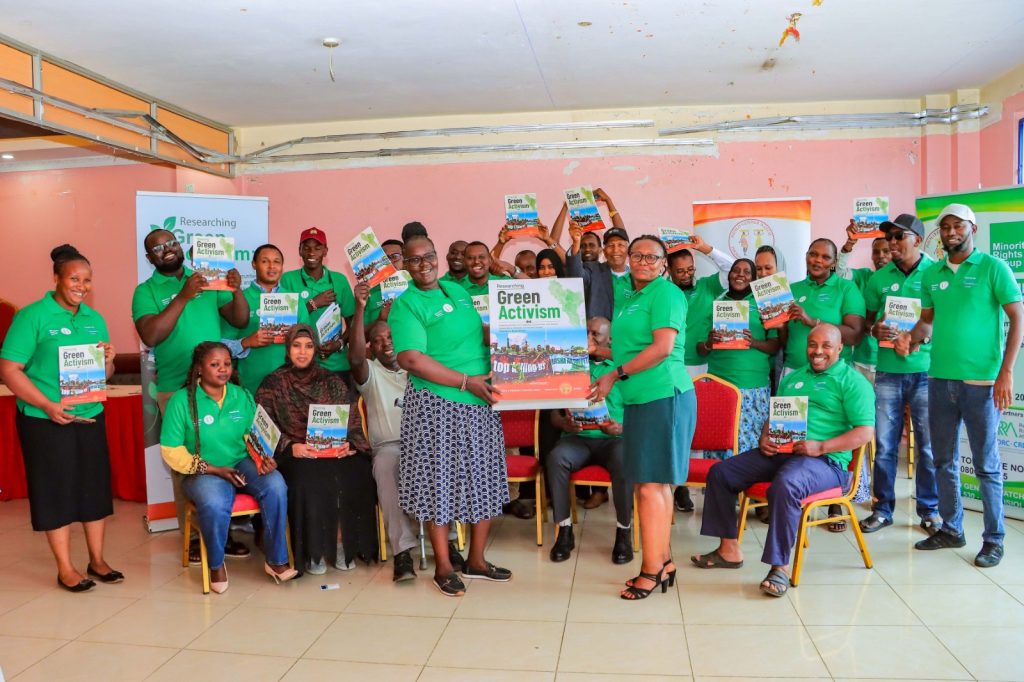
Minority Rights Group Africa Director Agnes Kabajuni (R) and Isiolo Gender Watch Executive Director Grace Lolim (L) join other Environmental Rights Defenders during the launch of a study on how to protect minority and indigenous communities,enviromental human rights defenders ,civil society organisations and Networks in East Africa. PHOTO Courtesy Betty Luke.
Environmental Human Rights Defenders (EHRDs) from Isiolo have called for stronger protection mechanisms and greater respect for Indigenous rights following the launch of a three-year study examining civic space and environmental justice in Isiolo and Marsabit counties.
The project under Research Green Activism Project, seeks to deepen understanding of the experiences of minority and Indigenous communities, civil society organizations, and climate defenders while identifying the drivers of threats they face and strategies to strengthen environmental activism across East Africa.
The study found that environmental defenders continued to face violence, intimidation, harassment, arbitrary arrests, fabricated court cases, and physical and digital surveillance as they advocate for climate action, land rights, and environmental protection.
According to lead researcher Guyo Haro, defenders face intimidation, arrests, abductions, and economic pressure for their work. The report notes that some EHRDs are branded as “saboteurs” or “agents of foreign governments,” while restrictive laws, delayed NGO registration and blocked donor funding are used to frustrate their work.
While 92% of respondents in Isiolo said they knew laws protecting their rights compared to 40% in Marsabit, the participation of women and persons with disabilities remained low in practice despite constitutional provisions.
Communities also reported being locked out of development because their land is not registered.
Rights crusader Kuresha Bille, who champions community land rights in Isiolo, said she hoped the findings would lead to stronger government action.
“We hope this report informs how the government will protect us. We also hope they will promote and ensure the implementation of laws that take care of our environment,” she said.
Marsabit’s Centre for Research Rights and Development CBO founder Mohammed Hassan said the project had strengthened defenders through capacity building enabling them to embark into fresh push for proper waste disposal in the county
“Through the capacity building sessions, we have begun conversations with the county government and other potential partners on how we can set up a recycling plant to support reduce non-biodegradable waste that continue to be illegally disposed,” he said.
The program was funded by the International Development Research Centre (IDRC) through a grant to Minority Rights Group Africa (MRG Africa).
MRG Regional Director Agnes Kabajuni said environmental defenders continue to face threats from multiple actors.
“Environmental defenders are faced with threats from the community, government and companies. Green Activism looked into these threats so that we can improve civic space and develop better strategies for the East African region,” she said.
She noted that Northern Kenya presented unique challenges due to competition over natural resources, extractive industries, climate change, and inter-ethnic conflicts adding the study captured the lived experiences of grassroots defenders and would now be shared with duty bearers to support advocacy and policy reforms.
In Isiolo and Marsabit counties, the program was implemented by Isiolo Gender Watch (IGW), a local rights organization that champions for the rights of indigenous women and girls.
Isiolo Gender Watch Executive Director Grace Lolim said the report provides evidence-based visibility to the experiences of Indigenous communities highlighting how climate change, shrinking civic space and weak protection mechanisms continued to undermine their rights, livelihoods and participation in environmental governance.
She added that the report also amplified indigenous voices and knowledge offering a strong foundation for policy reforms and more inclusive climate action that recognized and protected Environmental Human Rights Defenders.
According to the official, the next phase would focus on translating the findings into action.
“We must continue advocacy, community awareness, policy dialogue and monitoring to ensure the findings influence laws, development projects and climate governance at county, national and regional levels,” she said.
Lolim called on governments and other duty bearers to institutionalize protection mechanisms for environmental defenders.
“We urge national and county governments, security agencies and all duty bearers to protect Environmental Human Rights Defenders from intimidation and harassment, guarantee meaningful public participation, respect Indigenous knowledge, and ensure development and climate initiatives are implemented through transparent, inclusive and rights-based approaches,” she said.
The report recommended strengthening legal protections, ending state-led intimidation, and providing psychosocial support for defenders.
It also called for community engagement, targeted removal of invasive species, and integration of indigenous knowledge in conservation.
