

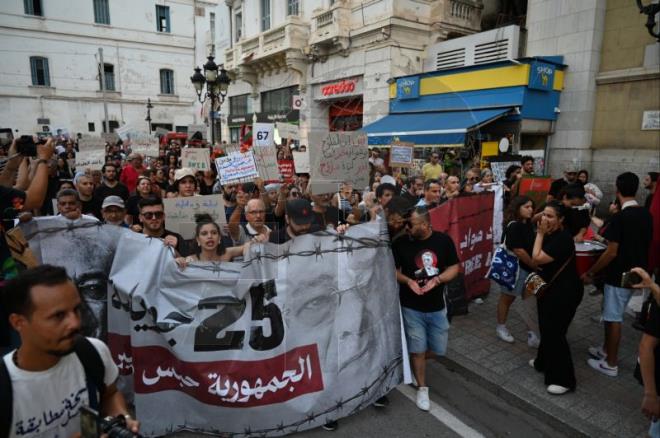
Hundreds of Tunisians gathered in the capital on Friday to voice their opposition to President Kais Saied, commemorating the fourth anniversary of his contentious takeover on July 25, 2021. The protests, where demonstrators called for the release of imprisoned critics and condemned Saied’s rule as an “open-air prison,” occurred just days before a presidential election widely criticized for its lack of fairness due to Saied’s maneuvers to disqualify most other candidates.
The demonstrations marked the anniversary of Saied’s decision to dismiss the government, suspend parliament, and consolidate executive power, actions that sparked both initial support and significant backlash. Opponents and international observers decried these steps as a coup, signaling the start of Tunisia’s shift towards authoritarianism. While some initially welcomed the move as a response to corruption and inefficiency, it has since been associated with the erosion of democratic progress achieved since the 2011 Jasmine Revolution.
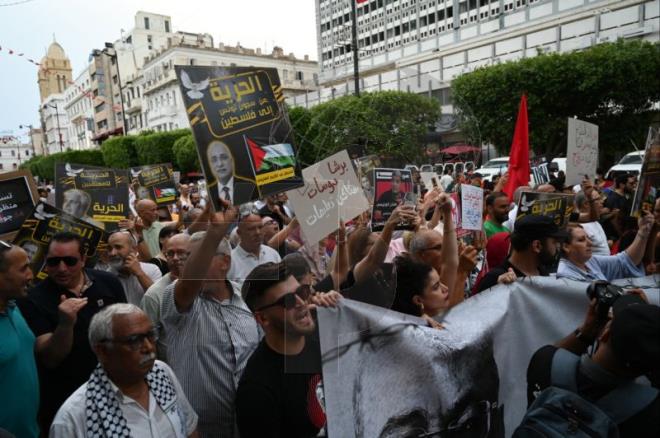
Protesters marched through Tunis, holding images of political detainees and a symbolic cage to represent the current state of political freedom under Saied. Their chants, including “no fear, no terror, power to the people,” underscored the growing discontent with the president’s policies. These include the disbanding of the Supreme Judicial Council and the Administrative Court, which have severely compromised judicial independence and the right to a fair trial.
Global human rights groups, such as Amnesty International and Human Rights Watch, have reported a decline in human rights under Saied’s leadership. Their findings include the imprisonment of numerous opponents, rising racism and xenophobia towards Black migrants, and threats to civil society. The International Commission of Jurists has also flagged the election for not meeting international standards for fairness and transparency.
These protests are part of a continuing pattern of resistance against Saied’s rule, with similar events occurring regularly since his power grab. His governance style has drawn comparisons to other authoritarian regimes in the region, raising alarms about the future of democracy in Tunisia, once seen as a model for post-Arab Spring reform.
As the election looms, the political crisis in Tunisia deepens, with opposition leaders and civil society advocating for a return to democratic principles and the reinstatement of independent institutions. The results of these protests and the upcoming vote will likely determine whether Tunisia can reverse its authoritarian slide or continue on a path of democratic decline.
